
You cancel plans. You cry at a commercial. You snap at someone you love — and immediately feel terrible about it. Then, just like that, a few days later, you're back. The fog lifts. The world feels manageable again. If this sounds familiar, you are not alone, and you are not "too emotional." You are simply living in a body with a cycle — and that cycle has seasons.
PMS (Premenstrual Syndrome) is not a personality flaw or a weakness. It is a physiological shift driven by hormonal fluctuations that affect your brain chemistry, your nervous system, and every cell in your body. Understanding what's actually happening — and having a gentle, powerful tool like yoga to meet it — can change everything.
Understanding Your Cycle's Emotional Seasons
Your menstrual cycle isn't one long flat stretch — it has four distinct phases, each with its own hormonal signature and emotional landscape. Knowing which phase you're in is like having a weather forecast for your inner world.
Rest & release
Energy returns
Peak confidence
PMS arrives
👆 The luteal phase is where PMS lives — and where yoga becomes your most powerful ally.
The luteal phase isn't something that happens to you — it's a phase you move through. And the key is not to fight it, suppress it, or schedule it away. The key is to have practices that soften the edges and regulate your nervous system before the symptoms take the wheel.
The Emotional Symptoms Nobody Talks About Enough
We talk a lot about cramps and bloating, but the emotional symptoms of PMS are often the most disruptive — and the most stigmatized. Irritability that feels disproportionate. A sadness you can't explain. Anxiety that appears from nowhere. Feeling disconnected from yourself, hypersensitive to criticism, or utterly overwhelmed by things that normally feel manageable.
These are not signs that something is wrong with your character. They are signs that your serotonin is lower, your cortisol reactivity is higher, and your nervous system needs support — not criticism.
Reading about yoga is one thing. Feeling it is another. Hit play for a gentle guided flow designed for exactly where you are right now — no experience needed, no pressure.
Move without pressure. Let your body lead. ✨
How Yoga Regulates the Hormonal Storm
Yoga works for PMS on multiple levels simultaneously — and that's what makes it uniquely powerful. Forward folds activate the vagus nerve, the body's built-in reset button for stress. Hip openers release tension stored in the pelvic region, where emotional stress often accumulates physically. Breathwork raises serotonin and lowers cortisol within minutes. And the practice of simply showing up for yourself on the mat — gently, without judgment — is itself a profound act of emotional regulation.
A 2026 pilot study found that women who practiced structured yoga twice a week during the luteal phase showed measurable reductions in anxiety, irritability, and sleep disturbance — without any other changes to their routine. The yoga itself was the medicine.

Your Luteal Phase Yoga Toolkit
🌿 Cat-Cow Flow (Marjaryasana-Bitilasana) — 3 minutes. This slow, rhythmic spinal movement massages the abdominal and reproductive organs, eases lower back tension, and — crucially — syncs your breath to your movement. That sync is neurologically calming. Let your exhale be longer than your inhale. Let your jaw soften. This is not exercise; it is a nervous system reset disguised as movement.
🌿 Wide-Legged Child's Pose — 3 minutes. Knees wide apart, hips sinking back, forehead resting. This variation creates space in the lower pelvis and abdomen — exactly where PMS tension accumulates. Place a pillow under your forehead if your neck is tight. Stay here longer than feels necessary. That extra minute is where the real release happens.
🌿 Supported Bridge Pose (Setu Bandhasana) — 2 minutes. Lie on your back, knees bent, feet hip-width apart. Lift your hips and slide a folded blanket or a yoga block underneath your sacrum. Now release all the effort. This passive version stimulates the thyroid, opens the chest, and improves pelvic circulation — a direct counter to the low-energy, low-mood heaviness of the luteal phase.
🌿 Reclined Pigeon Pose (Supta Kapotasana) — 90 seconds per side. Lying on your back, cross one ankle over the opposite knee and flex your foot. This is where emotional armoring lives — deep in the hip rotators. Stay with slow, full breaths. If you feel emotion rising: that is normal. That is the point. Let it move through you.
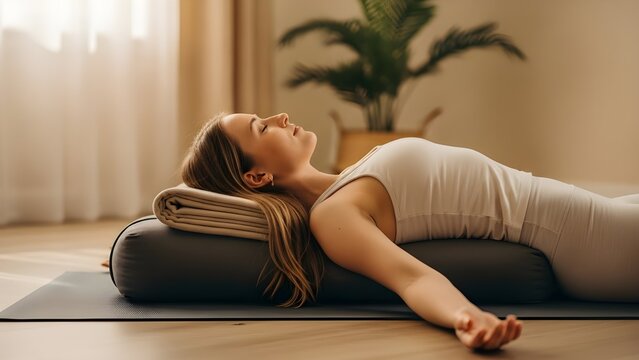
🌿 Yoga Nidra / Savasana — 10 minutes. This is not optional. Guided Yoga Nidra — the practice of conscious, progressive relaxation — has been shown to reduce cortisol, improve sleep quality, and restore emotional equilibrium. Play a Yogaendless guided track. Let your nervous system fully discharge. This single practice, done consistently in the luteal phase, may be the most impactful thing you can add to your cycle care.
Cycle-Syncing Your Practice: A Weekly Map
Rather than practicing the same yoga every day of your cycle, cycle-syncing means adjusting your practice to match your phase. In the follicular phase, you might enjoy more dynamic vinyasa and challenging poses. Around ovulation, arm balances and playful flows feel great. But as you enter the luteal phase — especially the final 7–10 days before your period — your body is calling for slowness, warmth, and restoration.
This doesn't mean doing less. It means doing what your body is actually asking for. Restorative yoga, gentle hip openers, long holds with supported props, and plenty of breathwork. Listen to the phase, not the social media pressure to be high-energy every single day.
🌸 Your Luteal Phase Check-In
🎥 Watch: A Gentle Flow for Your Luteal Phase
Sometimes words aren't enough — you need to feel it. Press play for a guided yoga practice designed to soothe your nervous system, ease emotional tension, and remind your body that it is safe. No experience needed. Just you, your breath, and a few quiet minutes.
Move without pressure. Let your body flow without force.
Explore more guided practices with Yogaendless.
Explore the Full Yogaendless Library
Hundreds of guided practices. Every level. Every mood. All in one place.
Visit Yogaendless →