💪 Strength & Yoga · Movement Science
Why Strong Yogis Move Better — Not Just Deeper
Flexibility without strength is just instability. The best yoga bodies are built, not just stretched.
Why Strong Yogis Move Better — Not Just Deeper
Depth is impressive. Control is transformative. Here's why strength changes everything.
There's a beautiful irony in yoga: the people who move most gracefully are almost always the strongest. Not the most flexible — the strongest. Flexibility gets the spotlight in yoga photography, but strength is what allows the body to move through that flexibility safely, sustainably, and with genuine ease rather than managed risk. This is the article that changes how you think about your practice.
💪 Flexibility without strength is borrowed range you can't actually use. Strength transforms passive stretch into active, controlled, injury-resistant movement.
3×Lower Injury Risk
40%More Range Accessible
EveryPose Needs Both
*Strength training alongside yoga significantly reduces soft tissue injury rates per movement science research.
The Flexibility Myth — Debunked Simply
When most people think of yoga, they picture someone folded in half or balancing on one finger. That image has made "flexible" the most envied quality in yoga — but it's actually the least useful one on its own. True mobility (usable range of motion) requires the nervous system to feel safe in that range, and safety comes from strength.
Think of it this way: flexibility is the size of your range. Strength is your ability to control it. Without strength, your nervous system guards your range — actively preventing you from accessing it because it doesn't trust you there. Build the strength, and that range opens up automatically. It's neurological, not just mechanical.
| 😬 Flexibility Without Strength | 💪 Flexibility With Strength |
|---|---|
| Passive range — body goes there but can't control it | Active range — body moves there with full control |
| Nervous system guards, restricts depth unconsciously | Nervous system trusts, releases restriction naturally |
| Risk of hypermobility strain at end range | Muscles support joints through full range |
| Poses feel unstable at depth | Depth feels grounded and sustainable |
The Strength Pyramid for Yogis
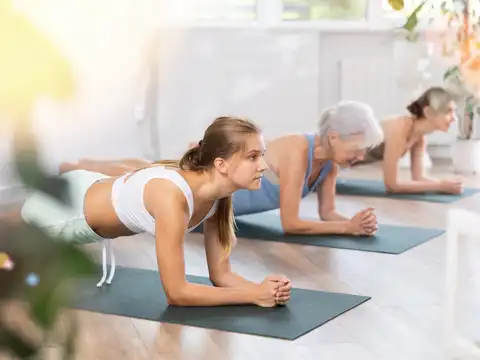
Not all strength matters equally in yoga. There's a clear hierarchy — tap each level of the pyramid below to understand what it means for your practice:
1. Core Stability — The Foundation
2. Joint Stability — Load Bearers
3. Eccentric Strength — Into Depth
4. End-Range Strength — The Peak
The neuroscience: Your nervous system uses proprioceptive signals from muscles to decide how much range to allow. Stronger muscles = more accurate signals = more range permitted. Stretching alone doesn't change this signal — but strength training does.
▶ WATCH & FLOW
Strength-Led Yoga Flow | Build the Control That Makes You Move Better
This is strength-in-yoga in practice — every pose loaded, controlled, and breathed through with intention.
Follow along. Breathe. Let your body lead.
More guided flows at Yogaendless.
Poses That Are Secretly Strength Work

Most people think of yoga poses as stretches. In reality, the most iconic yoga shapes are demanding strength movements in disguise — they just don't look like gym exercises.
1
Chaturanga (Low Push-Up)One of the most demanding tricep and shoulder movements in any discipline. Requires full-body tension, not just arm strength.
2
Chair Pose (Utkatasana)A loaded squat with arms overhead. Every major leg muscle fires, plus spinal erectors, shoulders, and core — simultaneously.
3
Boat Pose (Navasana)A hip flexor and deep core isometric hold. If it doesn't burn within 10 seconds, you're compensating with something else.
4
Warrior III (Virabhadrasana III)A single-leg balance requiring eccentric hip control. Every tiny wobble is a stabiliser working at its limit.
5
Crow Pose (Bakasana)An arm balance requiring wrist loading, core compression, and hip flexor strength — not flexibility. Zero flexibility is needed; all strength is.
How to Build Strength Into Your Yoga Practice
You can — but you don't have to. Yoga itself contains enough strength stimulus if you treat the poses as strength work rather than stretching. The shift is in intention: hold longer, resist gravity consciously, never collapse into depth.
It means isometrically activating the muscles around a joint even when no movement is happening. In Warrior II, squeeze the glute of the front leg. In Downward Dog, press the floor away. Active stillness is the yogic definition of strength.
Especially to you. Hypermobility means your range exceeds your body's ability to stabilise it. Strength work is the primary intervention — not more stretching. Focus on joint-stability exercises and isometric holds over passive stretches.
No — if you train through full range of motion (which yoga does). Strength built in the short, mid, and end ranges of a joint increases flexibility by making the nervous system feel safe enough to release restriction.
💪 Strength Check-In
Depth is not the destination — control is. Every centimetre of range you can move through with strength and breath is real mobility. Every centimetre you can only reach by collapsing into it is borrowed time. Build the foundation, and the depth takes care of itself.
🌿 YOGAENDLESS ONLINE CLASSES
Your Mat. Your Time. Your Practice.
Join Yogaendless for live group classes, private sessions & on-demand flows — beginner-friendly and built for real life. No experience needed. Just show up.
✦ Live & On-Demand✦ All Levels Welcome✦ Group & Private Classes✦ Practice Anywhere
Explore Classes at Yogaendless →
Next time you step on the mat, approach every pose as strength work. Hold a beat longer, resist gravity a little more, and let strength unlock the depth you've been trying to force.
▶ WATCH & FLOW
Strength-Led Yoga Flow | Build the Control That Makes You Move Better
Experience what it feels like to move from strength — not from flexibility alone.
Follow along. Breathe. Let your body lead.
More guided flows at Yogaendless.