A Beginner’s Guide to Headstands in Yoga
Yes, most healthy adults can work toward a safe headstand, but it takes building real strength first, not kicking up and hoping for the best. Here’s how to approach it without risking your neck.
What’s in this article
Key takeaways
- Headstand loads a significant percentage of your body weight through your neck, so building shoulder and core strength first matters more than flexibility.
- A wall, a teacher, or both make early practice meaningfully safer.
- Kicking or jumping up into the pose is one of the most common causes of injury.
- Certain conditions, including high blood pressure, glaucoma, and neck or spine issues, mean headstand isn’t for you, at least not without medical clearance.
- Progress at your own pace. A few breaths in a supported headstand is a completely legitimate stopping point, not a failure.
Why headstand gets called the “king of poses” (and why that’s a bit of a myth)
Shirshasana, or headstand, has a reputation as the ultimate yoga pose, the one that separates casual practitioners from “serious” ones. It’s a compelling idea: turn your whole world upside down and something in you shifts too. Many students describe feeling more focused, more energised, or simply proud of themselves after building up to it.
But the framing of headstand as a required milestone can push people to rush it, and rushing is exactly what causes problems. It’s worth knowing upfront that headstand is optional in any yoga practice. It’s not a test you need to pass to be “good” at yoga, and there’s no shame in skipping it altogether if it doesn’t feel right for your body.
Who should avoid headstand
Headstand isn’t right for everyone, and that’s completely fine. You should skip it, or only attempt it with a doctor’s clearance and a qualified teacher’s supervision, if you have any of the following:
- Neck, shoulder, or spine injuries, or recent surgery in these areas
- High blood pressure or a history of stroke
- Glaucoma or other eye conditions, including retinal issues
- Osteoporosis
- You’re pregnant or in your first weeks postpartum
This isn’t an exhaustive list. If you have any condition that inversions might affect, always check with your doctor before starting, and let your teacher know so your practice can be adapted for you.
Build the strength first
The single biggest shift in how headstand is taught over the last decade is this: strength and control come before the pose itself, not after. If your shoulders and core aren’t ready to support you, no amount of trying will make the pose safe.
Before attempting a full headstand, spend a few weeks on:
- Dolphin pose: forearms on the mat, hips lifted, building shoulder and core strength without any weight on your head.
- Plank and forearm plank holds: for core and shoulder stability.
- Wall-supported “egg shape” holds: knees tucked toward your chest with your back near a wall, getting comfortable being upside down before straightening anything.

A step by step beginner progression
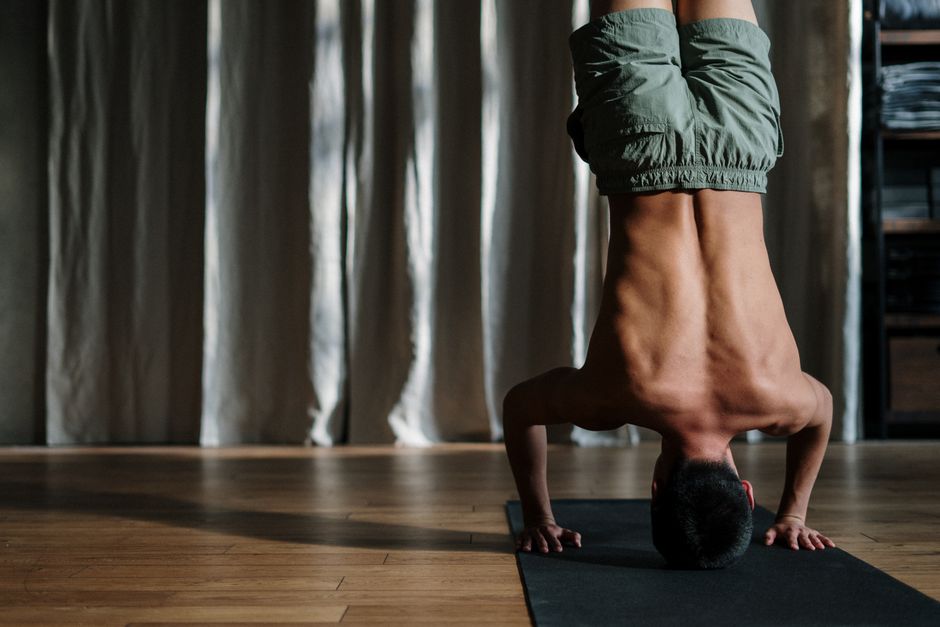
- Set your base. Interlace your fingers on the mat, forearms down, elbows shoulder-width apart. Place the crown of your head on the mat, cradled by your hands.
- Lift your hips. Walk your feet toward your head until your hips stack over your shoulders, similar to dolphin pose.
- Tuck one knee, then the other. Slowly bring your knees toward your chest, keeping your core engaged, rather than kicking up.
- Find your “egg shape.” Stay here for a few breaths with knees tucked, getting comfortable with your center of gravity before going further.
- Extend your legs slowly, if you’re ready. Only straighten your legs once your tucked position feels stable and controlled.
- Come down with just as much control. Bend your knees back to the egg shape, then lower your feet one at a time, finishing in Child’s Pose.
According to The Output by Peloton, even holding a supported headstand for just a few breaths is a completely legitimate goal for beginners, with duration something to build toward gradually rather than rush.
Common mistakes that lead to neck strain
- Kicking or jumping up. This creates a sudden shift of weight into the neck instead of a slow, controlled transfer.
- Putting weight on the top of the head with the neck flexed forward, rather than distributing weight between the forearms and head. Most modern cueing asks you to press strongly through your forearms to keep some of the load off your neck.
- Practicing without a wall or spotter early on. A wall behind you removes the fear of falling, which often causes the very tension that leads to strain.
- Ignoring pain. Discomfort from unfamiliar effort is normal. Sharp pain, tingling, or pressure in the neck is a signal to come down immediately.
Why we built the 21-Day Headstand Course
Most people who get hurt attempting headstand aren’t doing anything wrong on purpose, they simply don’t have a structured path to follow, so they skip the strength-building stages entirely. Our 21-Day Headstand Course exists to fix that: a sequenced program that spends real time on shoulder and core preparation before ever asking you to fully invert, with wall-supported practice built in throughout.
Everyone progresses differently. Some students are comfortable coming away from the wall within the three weeks, others use the full course simply to build a rock-solid foundation and continue practicing supported for longer, and that’s a good outcome too.
Watch and follow along
See some of these progressions in motion with our latest videos.


About Yogaendless
Yogaendless is an online yoga studio led by Anjali Pandey, offering live group classes, private coaching, on-demand flows, corporate sessions, and retreats, with a physical home at Loft 52, Bandra. Whether you’re working toward your first headstand or your first downward dog, there’s a way in that meets you where you are.
FAQ
How long does it take to learn a headstand?
It varies widely by person, depending on existing shoulder and core strength. Some students build a stable supported headstand in a few weeks, others take longer, and there’s no fixed timeline you need to hit.
Do I need to be flexible to do a headstand?
Not particularly. Headstand relies far more on shoulder stability, core strength, and balance than on flexibility.
Is it safe to practice headstand without a teacher?
It’s safer with guidance, at least while you’re learning. A teacher can check your alignment and weight distribution in ways that are hard to self-assess, especially upside down.
What if I have neck pain after practicing headstand?
Stop practicing the pose and rest. If pain persists or is severe, consult a doctor or physiotherapist before returning to inversions.
Can I practice headstand during pregnancy?
This depends on your individual circumstances and experience level, so it’s best discussed directly with your doctor and a prenatal-trained yoga teacher rather than answered generally.