
You wake up and reach for your phone before your eyes have fully opened. Within thirty seconds you've checked notifications, scanned headlines, liked a post — and felt hollow. This is not a character flaw. It is neurochemistry working exactly as designed — only the environment it was designed for no longer exists.
The human dopaminergic system evolved to reward novelty in a world of scarcity. Today that same system is flooded with thousands of micro-rewards per hour. Anxiety is at historic highs. Attention spans have compressed. Chronic restlessness feels normal — but it isn't. Yoga offers one of the most powerful antidotes available. Not as escape. As reset.
The average person checks their phone 96 times per day. Each check triggers a dopamine micro-dose, leaving the nervous system in a state of perpetual low-grade arousal that makes genuine rest nearly impossible.
What Dopamine Actually Does
Dopamine is not the "pleasure chemical." It's more accurately the wanting chemical — the engine of anticipation and pursuit. Every notification you check activates your dopamine circuits not to deliver satisfaction, but to promise that the next thing might. You're caught in a loop of wanting without arriving.
When dopamine floods the system repeatedly, the brain compensates by downregulating receptors — requiring ever more stimulation just to feel baseline normal. This is the same neurological mechanism underlying substance dependence, operating quietly within ordinary modern life.

The return to stillness begins not with discipline, but with conscious redirection of attention.
The Modern Nervous System Under Siege
Your autonomic nervous system toggles between sympathetic (fight or flight) and parasympathetic (rest and digest) states. Digital culture has quietly jammed the switch. Scrolling alarming news or a full inbox reads as a low-grade threat signal — cortisol trickles in, breath shortens, the prefrontal cortex goes partially offline.
You never get chased by a lion. But you never fully come down either. The result is a chronic sub-threshold stress state that accumulates silently — expressing itself eventually as burnout, insomnia, or the dull sensation of having forgotten what ease feels like.
Pause & Reflect
When did you last spend fifteen minutes without reaching for your phone or any form of external stimulation? What did the discomfort tell you about your relationship with stillness?
Yoga and the Neuroscience of Calm
Yoga is not a placebo. It is a precision intervention on the autonomic nervous system. Pranayama directly stimulates the vagus nerve — the primary parasympathetic pathway. Extended exhalations activate the vagal brake: heart rate decelerates, cortisol clears, the prefrontal cortex re-engages.
Asana contributes through proprioceptive interruption. Holding Warrior II requires your entire sensory attention. You cannot ruminate effectively while your hamstrings are asking for attention. The body can only ever exist in the present moment — and for the chronically overstimulated nervous system, this forced arrival in now is profoundly regulating.
A 2023 meta-analysis found that regular yoga significantly reduced cortisol, inflammatory cytokines, and self-reported anxiety — with effects comparable to pharmaceutical interventions in mild-to-moderate cases.
Specific Practices for Dopamine Reset
Yin Yoga: Poses held 3–5 minutes, targeting connective tissue. The long holds require you to befriend discomfort without reacting — directly training the impulse-regulation pathways dopamine overload has weakened.
Restorative Yoga: Fully supported poses held up to 20 minutes. Trains the nervous system to receive support without vigilance — a state many stressed people have lost access to entirely.
4-7-8 Breathing: Inhale 4 counts, hold 7, exhale 8. The extended exhale activates the vagal brake rapidly. Even five minutes before bed measurably shifts sleep quality.
Yoga Nidra: Guided conscious relaxation producing theta brainwaves. Regular practitioners report that a 45-minute session provides the restorative equivalent of several hours of ordinary sleep.
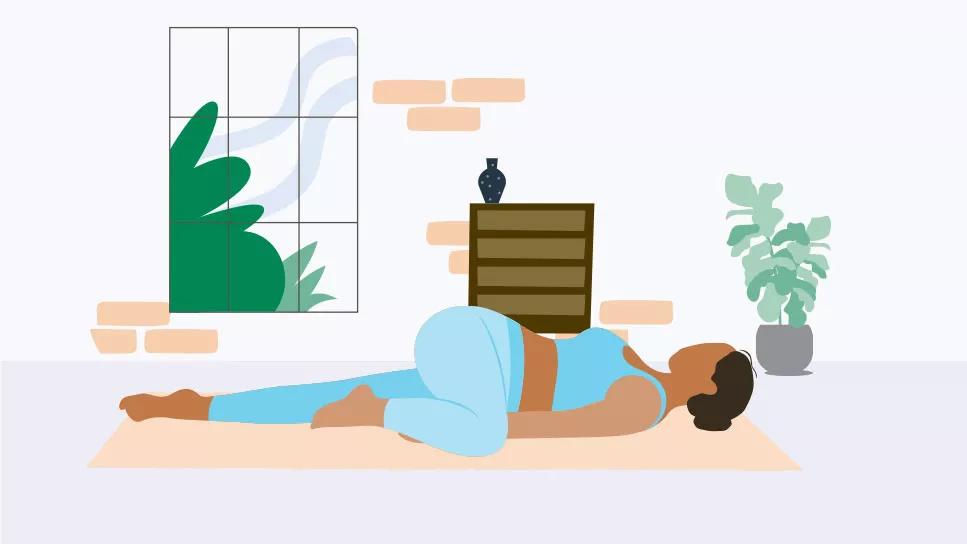
Yin yoga's extended holds teach the nervous system its most important skill: tolerating stillness without fleeing.
Building a Daily Reset Practice
Consistency matters more than duration. A twenty-minute daily practice recalibrates the nervous system more effectively over time than an occasional ninety-minute class. Begin each session with five minutes lying still in Savasana — not as the end, but as the beginning. Close your eyes before you reach for the phone in the morning, even for two minutes of conscious breathing.
Evening practices are particularly powerful: screens off thirty minutes before, low lighting, three to five Yin poses, ten minutes of Yoga Nidra. This sequence prepares the brain for deep, restorative sleep — the most powerful dopamine reset available, if we're not too stimulated to access it.
Mindful Check-In — Where Are You Right Now?
Coming Home to Your Body
Dopamine overload is not a personal failing. It is the predictable outcome of a nervous system shaped by evolution, operating inside an environment engineered to exploit its every vulnerability. Your yoga practice is not self-optimisation. It is the simple, radical act of returning — breath by breath, pose by pose — to the experience of being alive in a body that is always trying to bring you home.
Begin where you are. Breathe. Notice. That is enough — and it is, perhaps, more healing than you know.
Continue Your Practice with Yogaendless
Explore guided Yin Yoga, Yoga Nidra, and pranayama sequences curated for nervous system restoration — available whenever you're ready to return to stillness.
Explore Yogaendless →