How to Start Yoga With Zero Experience: A Beginner’s Guide
You don’t need to be flexible, fit, or familiar with any Sanskrit terms to start yoga. All you need is a bit of floor space and the willingness to show up.

What’s in this guide
Key takeaways
- Yoga is adaptable. Chairs, blocks, and walls can all make poses accessible from day one.
- You don’t need any equipment beyond comfortable clothes to try your first session.
- A short, consistent practice tends to build a habit faster than occasional long sessions.
- Always check with your doctor first if you’re pregnant, recovering from surgery, or managing a health condition.
Why starting yoga is worth it
Yoga is worth starting because it can support your body and mind at the same time, with very little barrier to entry.
Yoga combines movement, breath, and focused attention, and that combination is why it’s linked to a wide range of reported benefits. According to the National Institutes of Health, scientific evidence shows that yoga supports stress management, mental health, mindfulness, healthy eating, weight loss and quality sleep. Some of this is also about consistency: Harvard Health reports that people who practiced yoga for at least 30 minutes once a week for at least four years gained less weight during middle adulthood, and people who were overweight actually lost weight.
It’s worth being realistic about the evidence too. The NIH notes that only a small amount of research has investigated yoga for general well-being, such as improving sleep and reducing stress, and the findings haven’t been completely consistent, though some preliminary results suggest yoga may offer several types of benefit. In other words: yoga isn’t a guaranteed fix for anything, but many people do find it genuinely helps them feel better, physically and mentally.
Tip: You don’t need to decide if you “like yoga” after one class. Give yourself three or four sessions before you judge how it feels.
Common myths that stop beginners
The biggest myth holding new students back is that you need to be flexible before you start yoga.
According to a medically reviewed health guide, yoga for beginners is a gentle, adaptable practice that can improve strength, balance, stress, and flexibility when started safely, and part of the reason the myth persists is that yoga is often shown in its most extreme, advanced forms online. A beginner does not need to sit cross-legged comfortably, touch their toes, or hold long poses, and props like chairs, blocks, straps, cushions, and wall support can make the practice safer and more accessible. If you can breathe and move a little, you can start.
What you actually need to begin
To begin, you need comfortable clothing, a bit of floor space, and nothing else is strictly required.
- Clothing: something you can move in freely. A breathable shirt and athletic shorts or leggings that aren’t too loose tend to work well, since anything too baggy can get in the way during poses like downward dog.
- A mat: helpful for grip and knee padding once you’re practising regularly, but not essential for your very first try. If you’re new and haven’t bought one yet, many studios will let you borrow or rent a mat for the day.
- Water: keep a bottle nearby, especially if the space is warm.
- Props: if you’re practising at home, a rolled towel, a stack of books, or a scarf can substitute for blocks and straps until you decide you want the real thing.
Tip: Tie long hair back before you start. It sounds minor, but you’ll be glad you did the first time you fold forward into downward dog.
What to expect from your first session
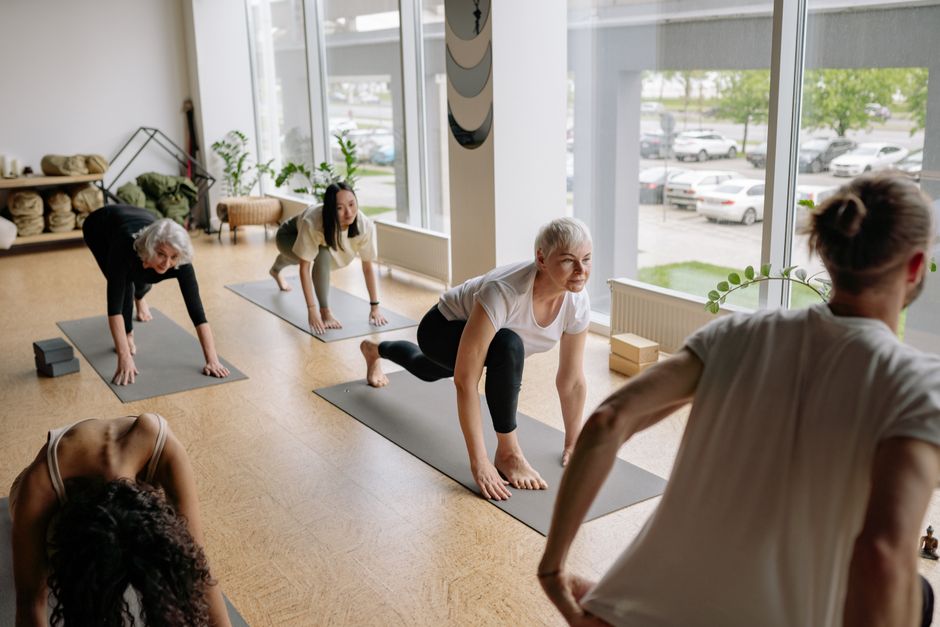
In your first session, expect a teacher to guide you through each pose with cues on breath, alignment, and modifications, at a pace slower than you might imagine.
A teacher typically guides you through the practice, offering cues for alignment, breath, and movement, demonstrating poses and providing modifications to help you stay safe and comfortable. If it’s an in-person class, that guidance often comes with hands-on adjustments too, which can be genuinely useful feedback when you’re starting out.
It’s completely normal to feel a little out of place in your first class. Everyone in the room started exactly where you are. The advice from instructors is consistent: go at your own pace, since it’s not about keeping up with others but about listening to your body and honouring its limits.
A few poses to get familiar with
Getting familiar with a handful of foundational poses before your first class can make the whole experience feel far less intimidating.
Foundational shapes you can practise from day one include Mountain Pose, Cat/Cow, Downward Facing Dog, Child’s Pose, and Warrior I, and these postures teach alignment, breath awareness, and how to find your edge without crossing it. You don’t need to master them, just recognise them, so that when a teacher calls out “child’s pose” you’re not scrambling to catch up.
One small technical detail worth knowing ahead of time: beginners often place their hands too close to their feet in downward dog, when the distance between hands and feet should roughly match a plank or push-up position. Small adjustments like that make a real difference to how a pose feels.
“The nerves before your first class are normal, and honestly, they’re a good sign. It means you’re about to try something new for yourself. My advice is always the same: come as you are, breathe when it gets hard, and rest whenever you need to. The mat will meet you exactly where you are that day, not where you were last week or where you think you should be.”
Anjali Pandey
Building a practice that sticks
The practice that sticks is usually the shortest, most consistent one, not the longest, most impressive one.
Incorporating a short daily session into your life can have a significant impact on your well-being, and there’s no rule that says a “real” yoga practice has to be an hour long. Ten to fifteen minutes, a few times a week, tends to be far more sustainable for a beginner than one ambitious 90-minute class that leaves you sore and reluctant to return.
Tip: Anchor your practice to something you already do, like right after you brush your teeth in the morning or before you sit down for dinner. It’s easier to stick to a habit that’s attached to an existing routine.
A note on safety
The safest way to start yoga is gradually, paying attention to how your body feels rather than pushing to match anyone else in the room.
As Johns Hopkins Medicine and other health experts note, a gradual approach, normal breathing, and attention to pain signals all help reduce the risk of strain or injury. Yoga can support many people’s overall wellness, but it isn’t a substitute for medical care. People with pregnancy, recent surgery, severe pain, dizziness, heart disease, or spine problems should check with a doctor about which styles and poses are appropriate for them before starting. If you have any existing health condition, it’s always worth a quick conversation with your doctor or physiotherapist first.
Frequently asked questions
Do I need to be flexible to start yoga?
No. Flexibility is something many people build over time through yoga, not a requirement to begin. Modifications and props make almost every pose accessible to beginners.
How often should I practise as a beginner?
Two to three short sessions a week is a reasonable starting point for most people. Consistency tends to matter more than duration, especially in the beginning.
Can I do yoga at home instead of in a studio?
Yes. Many beginners start at home with online or pre-recorded classes before moving to in-person sessions, and both can offer real benefit. The right choice often depends on whether you’re more motivated by structure or by flexibility of timing.
What if I can’t do a pose the way the teacher demonstrates it?
That’s expected and completely fine. A good teacher will always offer a modification, and using a block, strap, or wall isn’t a lesser version of the pose, it’s simply a way to meet your body where it is today.
Is yoga safe if I have a health condition?
Many people with chronic health conditions do practise yoga, often alongside their usual care. It’s best to check with your doctor first about which styles and poses suit your specific situation, since yoga is meant to complement medical care, not replace it.
If you’d like to see what a class actually looks like before you try one, take a look at a few of our recent videos.


About Yogaendless
Yogaendless is an online yoga studio led by Anjali Pandey, offering live group classes, private coaching, on-demand flows, corporate sessions, and retreats, with a physical home at Loft 52, Bandra, for anyone who wants to build strength, flexibility and calm, whatever their starting point.