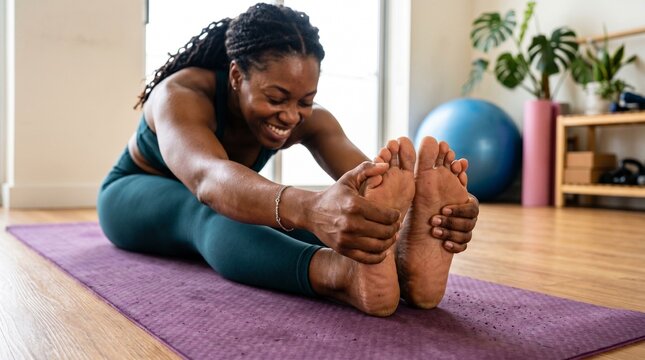
You stretch every day. You foam-roll. You've tried every hamstring stretch on the internet — and still, the moment you fold forward, that familiar tug says: not today. The frustrating truth is that chronic hamstring tightness is rarely just a flexibility problem. There's almost always something else going on — and your body is trying to tell you something.
Your Nervous System Is Playing Defense
Here's what most stretching guides skip: your hamstrings may not actually be short — they may be guarded. The nervous system constantly monitors muscle length and tension, and if it detects instability (in your hips, core, or lower back), it will reflexively tighten the hamstrings to protect you.
- Neural tension — the sciatic nerve runs through the hamstrings. When it's irritated, the muscles guard around it.
- Core weakness — if your deep stabilizers aren't working, the hamstrings compensate.
- Hip instability — the hamstrings brace to protect a pelvis that can't find neutral.
- Fight-or-flight residue — chronic stress keeps posterior chain muscles locked up.
Sitting Is Slowly Shortening Them
The average adult sits for 9–12 hours a day. In that position, the hamstrings spend most of their time in a shortened, slack state — and the hip flexors (especially the psoas) are constantly contracted. Over time, the brain recalibrates "resting length" downward, and what feels tight is simply the new normal your body has adapted to.
- Posterior pelvic tilt — slumped sitting pulls the hamstrings into chronic passive tension.
- Hip flexor dominance — tight hip flexors tilt the pelvis, which puts hamstrings on permanent stretch.
- No full range of motion — if you never use full hip extension, the brain stops making it available.
Hamstring Release — Yoga Flow for Deep Flexibility
This guided flow targets the real roots of hamstring tightness — breathe, release, and feel the difference from your very first session.
Follow along. Breathe into every edge.
More targeted flows at Yogaendless.
The Pelvis–Hamstring Connection Nobody Talks About
Your hamstrings attach to the sit bones (ischial tuberosities) — part of your pelvis. The tilt of your pelvis directly determines how long or short your hamstrings feel. People with an anterior pelvic tilt (common in desk workers and runners) are stretching their hamstrings constantly, making them feel perpetually tight even when they aren't short at all.
- Anterior tilt → hamstrings are always on stretch → feel tight even at "normal" length
- Posterior tilt → hamstrings are slack → brain signals them to tighten for stability
- Weak glutes → hamstrings have to pick up the slack → fatigue = chronic tension
What Actually Works (Hint: Not More Stretching)
Stretching alone often makes neural tension worse, not better. The smarter approach combines mobility, strength, and nervous system reset. Think of it less as forcing the muscle to lengthen and more as convincing your nervous system it's safe to let go.
- Active flexibility — strengthen the hamstrings through range of motion, not just passive holds
- Glute activation — strong glutes allow the hamstrings to release their compensatory grip
- Psoas release — freeing the hip flexors changes pelvic tilt and unlocks the posterior chain
- Breath work — exhaling into a fold signals the parasympathetic system to release the guard
- Regular movement snacks — short walks and hip mobility breaks every 45 min change everything
🧘 Mindful Check-In
Your hamstrings aren't your enemy — they're trying to hold you together when something else isn't. When you stop fighting them and start listening, that's when real release begins. Be patient, be curious, and let your practice meet your body exactly where it is today.
Your Mat. Your Time. Your Practice.
Join Yogaendless for live group classes, private sessions & on-demand flows — beginner-friendly and built for real life. No experience needed. Just show up.
Your hamstrings have been carrying more than their share — now you know why. Show up to your mat with curiosity instead of force, and you'll be amazed at how quickly your body responds.
Hamstring Release — Yoga Flow for Deep Flexibility
Your nervous system is ready to let go — let this flow guide it there, one breath at a time.
Follow along. Breathe. Let your body lead.
More guided flows at Yogaendless.