Why Your Hips Feel Tight and How Yoga Can Fix It
There's a peculiar cruelty to hip tightness — it gets worse the more you ignore it. You sit through another long day, rise stiffly from your chair, and feel that familiar resistance in your hips that seems to follow you everywhere: into your morning run, your sleep, your posture, your mood. Most people assume it's simply an age thing, or a body type thing, or just the way they're built. But hip tightness is rarely random, and it is almost never irreversible. There are specific reasons your hips feel the way they do — and yoga addresses every single one of them.
Understanding why your hips tighten is the first real step to getting lasting relief. Once you see the pattern — the cause, the effect, and the path through — it becomes far less frustrating and far more workable. The hips want to open. They simply need the right conditions to do it.
Sitting is the single biggest contributor to hip tightness in modern life. When you sit, your hip flexors — particularly the psoas and iliacus — remain in a shortened, compressed position for hours at a stretch. Muscles that are held short for long periods gradually adapt to that shortened length, making it feel impossible to fully extend or open them when you try. This is not weakness. It is adaptation. The body is simply doing what bodies do: becoming efficient at the shapes it stays in most.
Beyond sitting, there are other common culprits. Running and cycling both shorten the hip flexors while strengthening them, creating a muscular imbalance that pulls the pelvis forward. Poor sleep positions — particularly curling into the foetal position — reinforce hip flexion overnight. And then there's stress: the body's oldest response to threat is to curl inward, drawing the knees toward the chest and tensing the pelvic floor. For people who live with chronic anxiety or unresolved tension, this bracing pattern can run continuously in the background, day and night, without any conscious awareness of it at all.
Tight hips rarely confine their effects to the hip area. The pelvis is the body's structural keystone — everything above and below it is influenced by how freely it can move. When hip flexors are chronically shortened, they pull the front of the pelvis downward (anterior pelvic tilt), which causes the lumbar spine to curve excessively. This puts compression on the lower back discs and forces the lumbar muscles to work overtime just to keep you upright — leading to the fatigue and ache so many people blame on "a bad back" when the root is actually in the hips.
Further up the chain, a tight, tilted pelvis rounds the upper back and juts the head forward — adding kilograms of effective strain to the neck and shoulders. Further down, it changes the angle at the knee and loads the IT band unevenly. Even your breathing is affected: tight hip flexors restrict the full descent of the diaphragm, resulting in shallower chest breathing that keeps the nervous system in a subtle but persistent state of low-grade stress. One region of tightness, radiating into everything.
Why Stretching Alone Doesn't Fix ItMany people try to address hip tightness with static stretching — holding a lunge or a seated hamstring stretch for a minute or two and then moving on. This helps, but it rarely produces lasting change. Here's why: the muscle is only one layer of the problem. The connective tissue — fascia — that encases and connects your hip muscles responds to very different inputs than muscle does. Fascia requires sustained, low-intensity pressure held over time (typically 2–5 minutes) before it begins to hydrate, soften, and remodel. A 30-second stretch barely touches it.
More critically, if the nervous system is in a stressed state, it will keep the muscles contracted regardless of how hard you stretch. The psoas, in particular, is deeply wired to the body's stress response — it will not release while the body feels unsafe. This is why yoga's combination of long holds, conscious breathing, and intentional relaxation is so much more effective than isolated stretching. It addresses the muscle, the fascia, and the nervous system simultaneously. That's not a small distinction. That's the whole game.
 The Yoga Poses That Actually Work
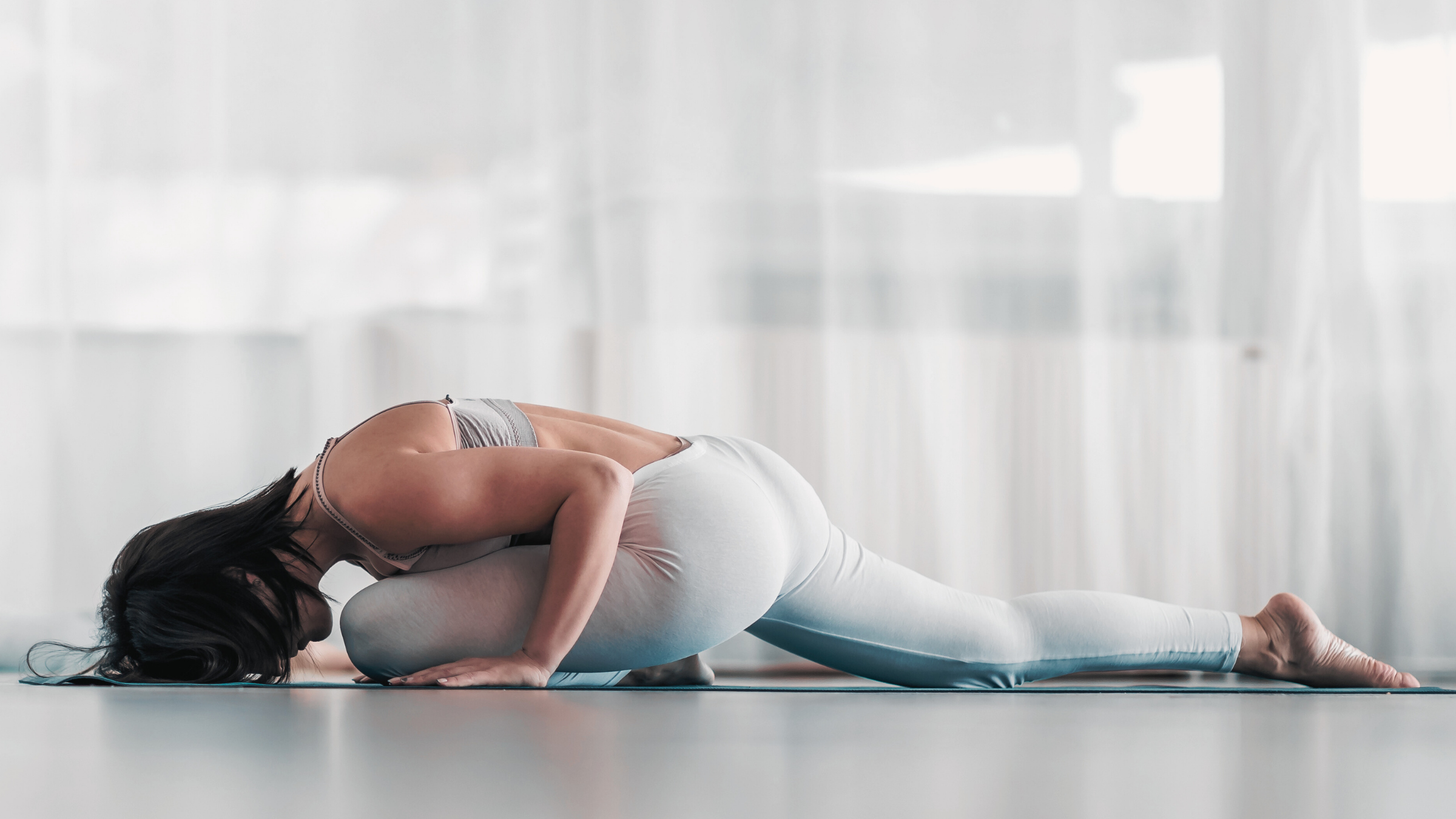
Not all hip openers are equal — and not all hip tightness responds to the same poses. If your tightness is primarily in the hip flexors (the front of the hip), Low Lunge (Anjaneyasana) and Crescent Lunge are your most direct tools. If it's in the outer hip and external rotators — the deep ache that flares when you try to sit cross-legged — Pigeon Pose (Eka Pada Rajakapotasana) and Figure-Four (Supta Kapotasana) are far more effective. Tight inner thighs and adductors respond best to Bound Angle (Baddha Konasana) and wide-legged forward folds. The key is matching the pose to the location of your restriction, then staying long enough for the tissue to actually respond.
For the deepest and most lasting results, yin yoga-style holds of 3–5 minutes per side are transformative. Your edge should feel like a sustained, tolerable intensity — never sharp, never breathless. If you can breathe slowly and steadily in the pose, you're in the right place. If you're gripping or bracing anywhere in the body, you've gone too far and the tissue will simply resist.
Building the Practice That Changes EverythingFixing hip tightness through yoga is less about finding the perfect pose and more about showing up consistently with the right approach. Ten minutes daily — morning or evening — of targeted hip work will create more lasting change over four weeks than an occasional hour-long deep stretch session. The tissue needs repetition to remodel; the nervous system needs repetition to trust. Begin standing with a hip circle or two to bring synovial fluid into the joint, then move through two or three targeted poses held for 2 minutes each side. Finish lying down: legs in a reclined figure-four or the soles of the feet together, letting gravity do the work for the final few minutes.
The most important shift you can make is one of intention. Don't come to your hip practice to fight your body into openness. Come to listen. Come to notice what's held there — the tension, the history, the patterns — and offer them a reason to let go. The hips don't open through force. They open through the accumulated trust that it is finally safe to do so. That trust is built, breath by breath, on the mat.
Mindful Check-In
Ready to begin? This guided flow takes you through a complete hip release sequence — addressing the hip flexors, external rotators, and inner thighs in one unhurried, breath-led practice. Show up as you are. Leave feeling different.
Move without pressure. Let your body flow without force.
Explore more guided practices with Yogaendless.
Hundreds of guided practices. Every level. Every mood. All in one place.
Visit Yogaendless →The hips are one of the most honest parts of the body. They hold what the mind has moved past, and they release when they finally feel heard. Your practice is that listening — and every session is a step toward the freedom your body has been waiting to rediscover.