
There's a particular kind of tired that has nothing to do with sleep. Your eyes are open, you've had coffee, you're technically awake — but the mind is thick, decisions feel harder than they should, and a conversation that would normally take five minutes stretches to twenty. This isn't laziness or distraction. It's cognitive overload: the brain genuinely running too hot, with too many open loops, too much incoming information, and nowhere near enough intentional recovery.
What Cognitive Overload Actually Is
The prefrontal cortex — the brain's executive centre, responsible for reasoning, planning, and decision-making — operates on a finite daily budget of glucose and neurotransmitters. Every decision, every notification, every context switch, every unresolved worry draws from this budget. When it runs low, thinking becomes slow, emotions become reactive, and the sense of mental fog sets in. This isn't metaphor — it's measurable metabolic depletion.
- The average worker switches context every 3 minutes — each switch costs 15–20 minutes of deep focus to recover
- Decision fatigue is real: the quality of decisions measurably deteriorates across the day
- Multitasking reduces effective IQ by up to 10 points — equivalent to missing a night of sleep
- The "open loop" — any unresolved task held in working memory — consumes cognitive resources continuously
- The brain uses 20% of the body's total energy despite being 2% of its mass — and it can exhaust its quota before noon
* Based on cognitive neuroscience research: Journal of Cognitive Neuroscience, Psychological Science, and attention restoration theory.
The Daily Habits That Restore Mental Clarity

Restore Mental Clarity — A Yoga Practice for the Overloaded Mind
When the mind is loud and the thoughts won't settle, the fastest solution is the one that works through the body first. Press play and let the noise clear.
Follow along. Breathe. Let your body lead.
More guided flows at Yogaendless.
Why Yoga Specifically Clears Mental Fog
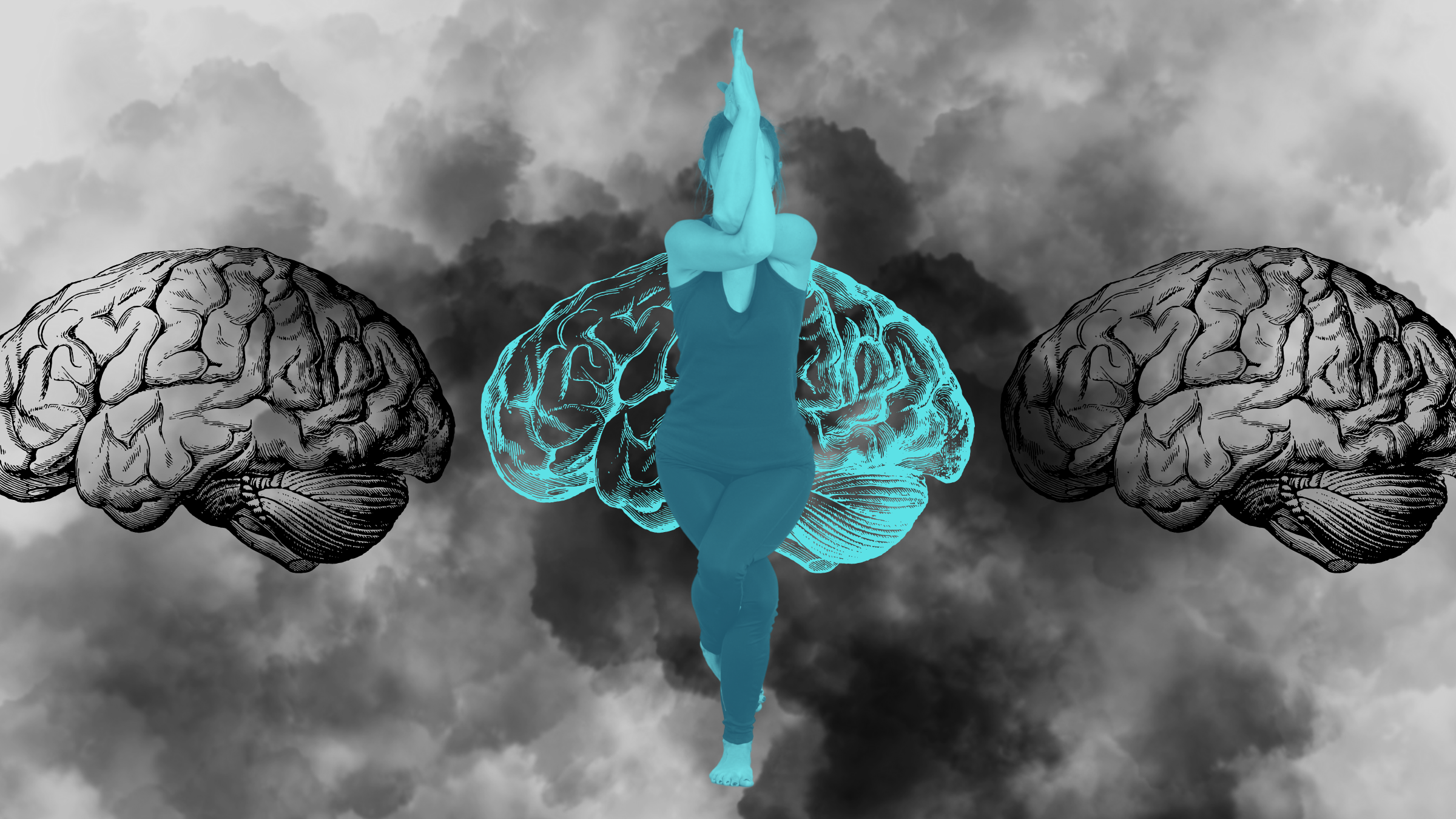
The brain's clarity is not restored by trying to think more clearly. It is restored by stopping the thinking — moving the body, attending to the breath, and allowing the default mode network to settle. Yoga is structured permission to do exactly that.
— Attention Restoration Theory applied to yoga- Slow movement — shifts blood flow from the prefrontal cortex (executive thinking) to the motor cortex, giving the PFC genuine rest
- Breath focus — gives the brain a single object of attention, displacing the multi-thread processing that causes mental fog
- Forward folds — mild inversion increases cerebral blood flow and is associated with improved cognitive performance post-practice
- Savasana — the default mode network's activity drops measurably in savasana, which is the neuroscience equivalent of defragmenting a hard drive
- Daily consistency — the BDNF (brain-derived neurotrophic factor) released during yoga practice literally supports neural regeneration over time
A Simple Daily Clarity Stack
You don't need to overhaul your life. You need to install three small recovery windows that prevent the overload from compounding. Think of these as cognitive hygiene — as non-negotiable as brushing your teeth, and approximately as time-consuming.
- Morning (5 min) — yoga or breathwork before any screen. Sets the PFC tone for the entire day
- Midday (2 min) — box breathing between the morning's work and afternoon's. Clears the accumulated context-switch debt
- Evening (10 min) — brain dump on paper + a short yoga flow. Closes the day's open loops so they stop consuming overnight working memory
- Weekly (once) — a longer yoga session (30–45 min) to restore deeper cognitive reserves that daily micro-practices maintain but don't fully replenish
The overloaded mind doesn't need more information, better software, or more discipline. It needs exactly what it's least likely to give itself permission for: a pause. A breath. A brief, deliberate return to the body. Five minutes of yoga delivers that return more efficiently than anything else available. The fog clears. The clarity comes back. Every time.
Join Yogaendless for live group classes, private sessions & on-demand flows — beginner-friendly and built for real life. No experience needed. Just show up.
The clarity is already there — it's just underneath the noise. A few deliberate minutes each day is all it takes to find it again.
Restore Mental Clarity — A Yoga Practice for the Overloaded Mind
This practice is what your brain looks like on the inside when you give it fifteen minutes to be quiet. Try it and see.
Follow along. Breathe. Let your body lead.
More guided flows at Yogaendless.